Saturday, September 7, 2019

Diet Eman: A Crisis of Faith

Diet Eman (courtesy of Diet Eman)

At Vught (a Dutch concentration camp), Diet was given a job cleaning bloody civilian clothing. As she was handed these garments, day after day, she made enquiries and discovered that she was washing the clothes of executed Dutch resistance men. She examined the clothing closely and discovered that the bullet holes were at the abdomen level. The resistance men had been deliberately shot in a manner that would cause a long, agonizing death.

At this point Diet's hatred for the Nazis ballooned until it threatened the very core of her Christian identity. It seemed that the painful execution of these Dutch men was the only reward she would ever know for all her Resistance work and her fervent prayers for everyone's safety. She began to doubt God's goodness and became physically paralyzed for several days.

Soon it was time for Diet's hearing. A fellow prisoner had promised to "storm the gates of heaven" for Diet so that her hearing would go well. As Diet went through the hearing, pretended to be uneducated Willie Laarman, she gradually realized that the healthy German officers seated comfortably in that room, who were there to decide her fate, were the real prisoners, not she. She became convinced that God was on her side. Her hatred for these Germans melted into pity, and she was filled with an overwhelming peace. 

She answered all of the questions asked of her with her carefully memorized details. Finally, when she was finished, one of the Germans who hadn't said a word during the session looked at her closely and said, "I have done nothing else my whole life by hearings and interrogations. That is my area of expertise...and I have developed a sixth sense. I can feel what is true and what isn't true. I can't put a needle through your story. It fits--all the way through. .But my sixth sense tells me it's all made up."

Excerpt from "Diet Eman: Courier for the Dutch Resistance" from Women Heroes of World War II. 


Wednesday, August 21, 2019

Hazel Ying Lee: Flying for China

Hazel at the Portland Flying Club, 1932.
Museum of Chinese in America (MOAC)


When Japan invaded Manchuria, the large northern province of China, in September, 1931, it caused great concern for people who lived thousands of miles away: Chinese Americans, many of whom had settled on the West Coast of the United States.

The Chinese Consolidated Benevolent Association in Portland, Oregon, decided to take action: it raised $20,000 and donated it to the local Chinese Flying Club in order to train young Chinese Americans to fly in Generalissimo Chiang Kai-shek's air force...


In March, 1933, Hazel and 16 other Portland Flying Club trainees left for China. But when she arrived, Hazel was told that the Chinese Air Force would not allow any woman pilots to fly military missions. Why? The Chinese Air Force officers claimed "women are erratic in combat."

Hazel was given a desk job with the Chinese Commission on Aeronautical Affairs and also flew for commercial flights, sometimes flying Soong Mei-ling, wife of the Generalissimo from place to place. She also flew over highly populated areas, dropping pro-Chinese leaflets to encourage Chinese resolve against the Japanese.

Her base of operation eventually became the populous southern city of Canton, where she opened a school for her young Chinese relatives. 

Hazel was still in China in 1937 when the Japanese began their campaign to conquer the entire country. When Canton was bombed in the spring of 1938, Hazel found safe shelter for herself and her family. Her friend Elsie Chang asked why she seemed so fearless. "If everybody else is afraid," Hazel replied, "there has to be somebody that could take over. And I'm the one to take over."

From "Hazel Ying Lee: American Flygirl" from Women Heroes of World War II. 

Tuesday, August 20, 2019

Hazel Ying Lee: WASP

Hazel is pictured on the left


The WASPs often faced serious hazards. One of the most perilous tasks for any stateside flier was ferrying what were called "war weary" planes, those that needed repairs or replacement. No one knew if they would stay in working condition on the way to being refurbished. But someone had to fly then. and WASPs often did.

Flying seven days a week in all sorts of weather and at high altitudes could also be dangerous, or, as in Hazel's case, at least hazardous to one's health. On October 14, 1944, she was grounded due to a severe respiratory infection. Chafing with impatience, she wrote a letter to Inez Woodward, a fellow WASP who had also graduated in the 43-W-4 class and who had worked with Hazel at Romulus.

In the letter, Hazel told Inez that she had received an offer from he former employer, the Chinese Commission on Aeronautical Affairs. Hazel wrote that she hoped to recruit ex-WASPs to fly in China. They had to have new plans because by now they had all received word that the WASP program would be disbanded in December.

Although Hazel seemed filled with hope for the future, the war was taking a toll on her. Sometime in 1944, she wrote a letter to her friend Elsie Chang, telling her that "this war is going on too long. I don't know whether I will make it or not."

From "Hazel Ying Lee: American Flygirl from Women Heroes of World War II: 32 Stories of Espionage, Sabotage, Resistance, and Rescue. 

Anna Yegorova: A Close Call


One day Anna was ordered to fly to the first Cavalry Corps--they needed a radio. But when she landed in the designated village, she didn't see them anywhere. Leaving the plane running, she ran to a nearby hut, tapping on the window to ask for information. An old man opened the door.

"Grandfather," Anna asked politely, "have our troops been through here?"

"Run away from here, Sonny," urged the old man, mistaking Anna for a man. "The Germans are here! They got here late last night!"

Anna turned around. There were Germans standing near the tent hut, their backs to her. But she couldn't seem to move her legs. The old man gave her a push, which did the trick. Anna ran to her plane and took off. Below her, she heard the crackle of machine gunfire. She looked down. The old man was lying facedown in the snow. And the Germans were now taking aim at her.

Excerpt from "Anna Yegorova: Soviet Pilot" from Women Heroes of World War II: 32 Stories of Espionage, Sabotage, Resistance, and Rescue. 

Melitta von Stauffenberg and the plot to kill Hitler

Melitta at an airfield, 1934.
Courtesy of Gerhard Bracke from his book, 


On May 21, 1944, Melitta wrote in her diary: "Early call, Claus, Berthold, Haeften, finally came to an agreement." Melitta, the two Stauffenberg brothers, and their close friend, Werner von Haeften, spent a long day together, swimming and sailing, activities that insured their conversations could not be overheard. On that day, most likely, Claus related to Melitta his plan to assassinate Hitler and overthrow the Nazi government. He asked if she would be willing to fly him to Hitler's military headquarters in the forests of East Prussia in order to do the deed, then fly him directly back to Berlin to announce the fuhrer's death and complete the coup.

Melitta agreed immediately.

She was now involved in aerodynamic tests designed to intercept Allied bombers. Her work, she felt, would save the lives of German Luftwaffe pilots and the German civilians being killed in the Allied raids. She was in no way trying to support Hitler. Quite the opposite--she blamed him for all these deaths, telling her trusted friends that he "needed to disappear as soon as possible."

From Melitta von Stauffenberg: "The Plot to Kill Hitler" from Women Heroes of World War II: 32 Stories of Espionage, Sabotage, Resistance, and Rescue. 

Hannah Senesh: Parachuting into Yugoslavia

Hannah and her brother, the day before she left to train with the British in Cairo. 


On the night of May 13, 1944, a plane took off carrying the first members of the Hungarian team, including Hannah and Reuven Dafne, a young Palmach man who had fought with the British Army and was the team's leader.

Reuven had his doubts about the ultimate success of the mission, but Hannah's intense optimism affected him. As they flew to Yugoslavia, Reuven saw that her face "exuded happiness and excitement."

The roar of the plane's motor made conversation impossible, but just before Reuven jumped, Hannah, her face "wreathed in a smile," gave him a thumbs-up. She jumped right after him but was blown far from Reuven's landing spot because she was lighter than he was.

After the the partisans found them, the team walked four days to headquarters, where they learned the German invasion of Hungary had just occurred. Their rescue mission now seemed impossible.

"We are late, we are late," Hannah cried. What will happen to all of them...to the million Jews in Hungary? They're in German hands now--and we're sitting here...just sitting."

Excerpt from "Hannah Senesh: British Paratrooper" from Women Heroes of World War II: 32 Stories of Espionage, Sabotage, Resistance, and Rescue. 

Wednesday, February 22, 2017

Sophie Scholl's day in court


Hans Scholl, Sophie Scholl, Christoph Probst,
Munich Train Station, July 23, 1942

"On February 22, 1943, a German university student named Sophie Scholl, her brother Hans, and one of their friends, Christoph Probst, were awaiting trial in the "People's Court" in the Munich Palace of Justice. The judge who was to preside over their case, Roland Freisler, suddenly swaggered into the courtroom, dramatically dressed in flowing red robes. Judge Freisler was known as the hanging judge because he passed death sentences on nearly everyone tried in his court.


This trial, its audience filled with those loyal to Hitler's Third Reich, looked like it would be no exception. Judge Freisler opened the proceedings with a furious and demented tirade, making great billowing gestures with his robes and screaming that the defendants were guilty of treason, conspiracy, rendering the armed forces unfit to protect the German Reich, giving aid to the enemy, and weakening the will of the German people.


The defendants were not given a chance to speak on their own behalf, but in the midst of the judge's tirade, Sophie suddenly cried out, 'Somebody had to make a start! What we said and wrote are what many people are thinking. They just don't dare say it out loud!'"


Opening paragraphs from "Sophie Scholl: The White Rose" from Women Heroes of World War II.

Wednesday, June 22, 2016

Andree Virot and the broadcasts of Charles de Gaulle

Andree Virot

"Andree didn't understand how precious her freedom or her country were until the day she lost both to the Germans. When it became clear the Germans would now control what was printed in the newspapers, Andree suddenly wanted to fight for the freedom to know the truth. So when she and her friends heard Charles de Gaulle's radio message from London, they decided to copy and distribute it. Then she began to work for Brest's underground newspaper."


Charles de Gaulle broadcasting from London

De Gaulle's speech of June 22nd is likely the one copied by Andree and her friends.


Wednesday, May 25, 2016

Andrée de Jongh and the Comet Line


One of the most successful World War II rescue operations was initiated by a young woman named Andrée de Jongh.

Andrée was born in 1916 in German-occupied Belgium and was raised in the shadow of the Great War.  Long before she reached adulthood, De Jongh’s father, a schoolmaster, made certain his daughter was well-versed in Belgium’s wartime history, its villains and its heroes. Topping the list of the latter were two women executed in Brussels by the Germans: Belgian spy Gabrielle Petit and British nurse Edith Cavell.
Gabrielle Petit commemorative statue

Andrée’s admiration for Cavell was so great that after becoming a commercial artist, she also trained as a first aid worker. And when the Nazis invaded and occupied Belgium in the spring of 1940, Andrée became motivated to emulate Cavell in an additional way: resistance work, specifically the rescue of Allied servicemen.

French propaganda poster depicting Cavell's execution.

During the First World War, Cavell had facilitated the escape of Allied servicemen from German-occupied Belgium and France by hiding them in her Brussels clinic, then arranging their escape across the guarded border between Belgium and the neutral Netherlands. Andrée had a more difficult task: Belgium was now surrounded on all sides by German-occupied territory. She, along with her father and several others, decided to commence an enormously ambitious project: a 1,200 mile escape line that would take trapped servicemen from Belgium through occupied France, by way of safe houses along the route, and then across the Pyrenees Mountain range into neutral Spain.

Although the operation’s trial run ended in failure, Andrée refused to quit. Instead, she decided to ask for British assistance. But when she appeared at the British consulate in Balboa, Spain, with three rescued Allied servicemen, the official didn’t believe that this petite, youthful, neatly-dressed young woman was a resister who had just traversed the wintery Pyrenees peaks. Rather, he suspected her of being a German spy. But Andrée eventually won him over before also gaining the support of MI9, the wartime intelligence organization tasked with rescuing stranded British servicemen.

While there were many Belgians involved in Andrée’s operation – eventually termed the Comet Line for its unusual swiftness -- Andrée made 32 round trips on the line, personally guiding 118 servicemen to freedom. But on January 15, 1943, during her 33rd trip, Andrée  was betrayed into the hands of the Germans.  She admitted responsibility for the entire operation but because of her youthful appearance they didn’t believe her. However, because she wouldn’t betray anyone else, they sent her to the Ravensbruck concentration camp.
Photo taken shortly before her arrest.

The Comet Line continued to run in Andrée’s absence, ultimately rescuing approximately 700 Allied airmen. Andrée managed to survive the war and received multiple awards from Belgium, France, Great Britain, and the United States. After regaining her health, she became a nurse and worked in various leper colonies in the Belgian Congo and Ethiopia. When her eyesight began to fail, she returned to Brussels where she died in 2007 at the age of 90.

In Andrée’s Washington Post obituary, Peter Eisner, WP editor and biographer of the Comet Line, claimed it was “the greatest of escape lines in Europe in numbers of rescues as well as the most sophisticated, longest operating and most successful."  The value of Andrée’s work, Eisner stated, “went beyond the individuals she was saving. She gave hope to aircrews in England before they took off that there was this angel of mercy working in occupied territory that had a complete system working to find them. It was a great psychological boost."

Novelist Kristin Hannah has stated that she was inspired to write her best selling novel, The Nightingale, after encountering Andrée’s story. Read the interview here.

Andrée is one of the women featured in my young adult collective biography (geared for readers 12 years and up), Women Heroes of World War II: 32 Stories of Espionage, Sabotage, Resistance, and Rescue

The stories of Andrée's First World War inspirations, Edith Cavell and Gabrielle Petit, can be found in my second YA collective biography, Women Heroes of World War I: 16 Remarkable Resisters, Spies, Soldiers, and Medics. 


Airey Neave, an agent of MI9, wrote a biography on Andrée called Little Cyclone: The Girl WhoStarted the Comet Line.

The book SilentHeroes: Downed Airmen and the French Underground, by Sherri Greene Otis, contains a lengthy, detailed section on the Comet Line.

And finally, Andrée is featured in my novel, The Belgian Girls; two of the fictional characters work on the Comet Line. 


Thursday, March 24, 2016

Corrie ten Boom and the Dutch Resistance

Corrie ten Boom in 1915


"After more Jews found their way to the Beje, Corrie realized that she needed extra ration cards, the only means by which people in Nazi-occupied countries could buy food. A man named Fred Koornstra kept Corrie supplied with extra radion cards. His developmentally disabled daughter had been attending Corrie's church services for 20 years and he worked in the Food Office, where ration cards were issued. Corrie shared these cards with others who were sheltering Jews and other refugees. Soon the Beje became the center of a network of local Resistance workers.
 
The Beje became a permanent home for several Jewish refugees and a temporary one for many more (never more than 12 at one time) who would pass through on their way to find a safer hiding place out in the country.
 
Members of larger Dutch Resistance network heard about the refugee work at the Beje and sent an architect to create a secret room adjacent to Corrie's bedroom, big enough to hide all the refugees living at the Beje at any one time. then an electrician was sent to install a buzzer warning system that would alert everyone to go to the secret room in the event of a Gestapo raid."
 
From "Corrie ten Boom: Watchmaker, Rescuer, Reconciler" from Women Heroes of World War II: 26 Stories of Espionage, Sabotage, Resistance, and Rescue.


Tuesday, April 21, 2015

US Army nurse veteran of the Ardennes Campaign recalls VE Day and beyond

Muriel Phillips Engleman, US Army nurse, next to a pillbox in Liege, Belgium, October, 1944, while waiting for the construction of her unit's tent hospital.
She and her unit would soon nurse Battle of the Bulge casualties.
 
 
I asked Muriel for her memories of VE Day and this is what she sent me:
 
"One word sums it up--we were euphoric. We knew it was coming but when the final realization of the signing of Germany's surrender set in, we couldn't contain our relief, at last the killings were over! The local Belgians swarmed around our hospital yelling "Fini la guerre!" (the war is over).

And amidst my memories of that day are also feelings of guilt because of an  unkept date I had made with a recently released American POW officer, a patient in our hospital, who asked to see me that night in our officer's club tent and I agreed. However that afternoon the colonel of our hospital offered the use of a truck to take the nurses to the large officer's club in Liège to celebrate and I dearly wanted to be with my buddies, the women I had worked with through thick and thin the past three years, to celebrate with them. I never had a chance to contact the officer who wanted to date me that night and hopped on the truck along with the other nurses. Of course I felt guilty for "standing him up," especially after him being a POW of the Germans for several months and he was so happy to be free and dating an American woman.

Then, a few days later, when  reality of the war being over settled in, came the haunting thoughts that the war with Japan was still going on and instead of heading for home, we'd end  up getting shipped to the CBI (China, Burma, India Theatre of Operations)...

The months between May and August: in June we received orders to move back to Chalons-sur-Marne in France and run a hospital there in an old French riding caserne, and I was working with 600 Kraut POW's. They figured that because i was Jewish I could speak Yiddish, similar to German but of course, I couldn't speak a word. I did learn how to say "haben zie schmertzen?" (have you pain? and" Vo is die schmertzen"--where is the pain. The patients were between the ages of 14 and 67, and the big blonde arrogant SS Troopers weren't so arrogant at this point. Chalons was a horrible dust bowl  town, nothing to do on our days off unless we took an overnight and hitched a ride on a truck to Rheims , the champagne center and there was a nurses R & R building there, and shopping and sights to see.

In Sept. they sent us on a week's leave just to kill time and I went to Switzerland and then they moved us to a staging area to get ready for the trip back to the U.S. and the waiting was horrible, nothing to do in these staging areas, usually out in the boondocks, read, stay in bed, nothing much to explore or transportation for exploring and the  rumors flew thick and fast.
 
Our luggage was sent to Marseille but we finally left from le Havre (and our luggage arrived there eventually also) and we sailed out about mid Nov. for the  U.S. Slowly passing the Statue of Liberty about  6;30+ a.m. was the most beautiful sight in the world and there wasn't a dry eye aboard that ship of thousands of returning servicemen and women."


Muriel has written a memoir, which includes eleven chapters regarding her wartime experience, called Mission Accomplished: Stop the Clock. Her story is also included in the young adult collective biography, Women Heroes of World War II.


Tuesday, September 23, 2014

Noor Inayat Khan: The Gestapo Closes in

  
The Gestapo knew there was a radio operator in Paris, but for months Noor successfully eluded them. They failed to track her down because Noor was careful to transmit from many different locations and because she transmitted very quickly. She also possessed a keen intuition that alerted her to the dangers of being followed or the overtures of too-friendly strangers.
Noor's fellow agents knew that the Gestapo was closing in on her and urged her return to London. But she refused to leave until they could send a replacement. Once she was assured that this would happen, she would make plans to return...
Excerpt from "Noor Inayat Khan: Royal Agent" from Women Heroes of World War II. 

Monday, May 28, 2012

A very special History Day project


Cinthia, Mariah, and Victor

Janet Kelly’s email took me by surprise. Kelly is a middle school teacher who coached a three-student team through an impressive History Day project, using my book as the foundation. Of the 26 women featured in Women Heroes of WWII, Ms. Kelly's students decided to focus on Josephine Baker, Irene Gut, Nancy Wake, and Sophie Scholl. “They have cut out four women's silhouettes out of wood, and put them together like a jigsaw puzzle” Kelly told me. “The pieces stand up when they are put together, but fall down if they are apart. They wanted to demonstrate that these women, and all the others like them, had accomplished much as individuals, yet the real power is what they did together as a collective whole.” She went on to explain that the kids knew nothing about WWII before beginning the project. “One of them told me that WWII was fought so girls could wear Levis to school” Kelly said. The following questions they sent to me via their teacher proved that they’d learned something during the project:

“How important were the resistance groups to the war effort?”

“Why would the Nazis have treated Sophie so badly?”

“What do you think would have happened if the Nazis would have won the war?”

“Do you think we are on the right track with how the exhibit is put together?”

“Were there reforms in Europe that happened because of the Allies winning the war?”

“Do you think the artifacts are a good idea?”

I won't take up space here with my answers because because the point of this post is to exhibit the impressive amount of thinking that was stirred in these students. I’ve had many inspiring moments since I commenced the writing of Women Heroes but I’d say that my correspondence with Janet Kellly will always be very close to the top. Here are her final comments: “You have had a major impact on these kids. I think your book is beyond inspiring...what a legacy to leave future generations. I think the way it is written and illustrated make the information easily accessible and memorable. I plan to keep it in my library, and will eventually donate it to the school library. Thanks again for your willingness to help us.”


There was a spot for "artifacts": food representing Irene Gut . . .

A suitcase representing Sophie Scholl . . .


And tap shoes representing Josephine Baker.


I had to include this -- I've never been quoted in a school project before. :)

Great job, kids!!

Sunday, March 11, 2012

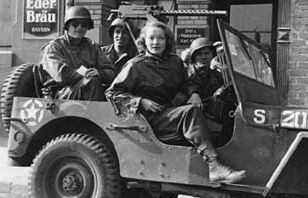
Marlene Dietrich: Tireless German-American entertainer for the Allied troops


"Marlene was frequently in serious personal danger. Gunfire and the sound of exploding bombs often provided the backdrop to her songs. More than once, her shows had to be stopped either because the soldiers received orders to "move out" or enemy fire had come too close to the stage. But Marlene didn't care; she was a tireles and determined entertainer.  She would often urge her fellow USO entertainers to drive as close as possible to the front lines of battle, do a short show for the servicemen there -- just a few songs and jokes -- and then drive back as quickly as possible.

The most dangerous event that Marlene experienced during the war occurred when she was traveling with a division of U.S. soldiers into the Ardennes Forest and entered a crucial battle of World War II: the Battle of the Bulge . . ."

Excerpt from "Marlene Dietrich: The Only Important Thing" from Women Heroes of World War II: 32 Stories of Espionage, Sabotage, Resistance, and Rescue.

Thursday, March 8, 2012

Stranger at the door: Magda Trocmé

Magda Trocmé with her family in the late 1930's
Trocmé family collection

Magda Trocmé, the wife of the Protestant pastor André Trocmé, lived with her family in the small French village of Le Chambon-sur-Lignon. She was cooking dinner one evening when she heard a knock at the door. Who could it be at that time of day? When she opened the door, she saw a woman covered with snow, shivering with fear and cold. The woman asked if she could come in. Magda guessed that the woman must be a Jew. She also knew that it was illegal to hide Jews.

Opening paragraph from "Magda Trocmé: Wife, Mother, Teacher, Rescuer" from Women Heroes of World War II: 26 Stories of Espionage, Sabotage, Resistance, and Rescue.

Sunday, February 5, 2012

US Army Nurse Corps booklet cover

Courtesy of Muriel P. Engelman, WWII U.S. Army Nurse, retired R.N.

Muriel, who eventually nursed men wounded in the Battle of the Bulge, has this to say about the different uniforms they were issued:

"When we first were commissioned, we wore navy blue dress uniforms and the navy cape but then sometime in '43, they changed to olive drab before we went overseas and the summer dress uniform was beige--but I was overseas for about 9 months before that arrived.  In the winter months we wore the olive drab combat pants but come Easter Sunday we were allowed to wear the brown and white seersucker wrap around uniforms that looked like maternity dresses but the effect on the G.I.'s , both in England and in Belgium on those Easter Sundays was the same. The patients hooted and whistled and yelled, "They've got legs!" So, it was good for their morale and our egos."

"We did not wear our white army uniforms once we went overseas but wore drab fatigues or coveralls, that we called "zoot suits." Then just before we went to France we were issued our "combat pants" with liners that provided more warmth than the fatigues, and wore long underwear under the liners once winter set in for good in Belgium. And our helmet liners were the head gear we wore all the time, replacing the nurses' caps. During periods of bombings, then we wore the three pound steel helmets over the helmet liners, when we'd try to worm as much of ourselves as possible into those helemets."

Muriel's wartime activities are included in her memoir, Mission Accomplished: Stop the Clock and in the U.S. section of Women Heroes of WWII  (she is the leader of the nurses marching across the cover of the book).

Tuesday, December 6, 2011

Muriel Phillips: A Nursing Student on December 7th, 1941


Muriel Phillips during the Battle of the Bulge.  Photo courtesy of Muriel P. Engeelman


When Muriel Phillips heard the news, on December 7, 1941, that the United States Navy had been bombed by the Empire of Japan, she was in her final year of nurse's training at Cambridge Hospital in Cambridge, Massachusetts. The following day, all the nurses on her floor gathered around the radio in the doctor's office to hear President Roosevelt give his "Date of Infamy" speech, which informed the American people that the United States had declared war on Japan.

There was no question in Muriel's mind what she would do: right after she finished her nuse's training, she would enlist in the armed services as an army nurse.

Opening paragraphs of "Muriel Phillips: US Army Nurse" from Women Heroes of World War II: 26 Stories of Espionage, Sabotage, Resistance, and Rescue.

Muriel's memoir: Mission Accomplished: Stop the Clock.

Monday, August 1, 2011

Irene Gut: A Choice


The hotel was right next to Radom's Jewish ghetto, and one day Irene witnessed a horrible sight. Jews in the ghetto -- including pregnant women and children -- were screaming, trying to run from SS officers who were chasing them down, trying to kill them. Then Irene saw one officer catch a mother holding an infant. With one movement of his hand, he pulled the baby away from its mother and threw it to the ground on its head.

Irene was horrified. She had been raised in a very sheltered, religious home and couldn't understand how God could allow such terrible things to occur. She wanted to turn her back on God, to leave her faith. But then she realized something; God gives everyone a free will, to choose either good or evil. The Nazis had obviously chosen evil. What would her choice be?

Irene already knew the punishment for helping Jews. She had seen and heard the warning many times, on posters and loudspeakers broadcasting in the street: "Whoever helps a Jew shall be punished by death." Irene made a decision. She told God that if she had an opportunity to help the Jews, she would, although it meant risking her own life . . .

Excerpt from "Irene Gut: Only a Young Girl" from Women Heroes of World War II: 26 Stories of Espionage, Sabotage, Resistance, and Rescue.

Irena Sendler: Rescuer of Jewish Children


...Even as she was imploring children to memorize their new Christian identities so that their lives could be saved, Irena was also preserving each child's true identity. She made up a list on small strips of tissue paper that contained each child's false Polish name, true Jewish name, and the location where he or she was currently living. She placed two identical lists into two separate bottles and buried them under an apple tree in a friend's yard. She had to be extremely careful in hiding the lists; if the Nazis found them, they would be able to track down every single child Irena had saved.

On October 20, 1943, Irena was having a party to celebrate her name day (the date she had been baptized in the Catholic Church). She set aside the identification lists that she had been updating. Her friend, an associate in the work to hide Jewish children, stayed overnight.

Suddenly, in the early morning hours, there was a horrendous pounding at the door. It was the Gestapo!

Excerpt from "Irena Sendler: Life in a Jar" from Women Heroes of World War II: 26 Stories of Espionage, Sabotage, Resistance, and Rescue.

Monday, June 27, 2011

Hortense Daman: One Last Chance

A tall German officer in an SS uniform stepped onto a train car loaded with female prisoners, their hands and feet chained to their train seats. He glanced around the car until he noticed one particular prisoner, a pretty 17-year-old girl. He walked over to her.

"I'll give you once last chance," he said.

"I don't understand," the girl replied.

The officer almost smiled. "I'll give you your freedom, set your free, if you can tell me where I can find your brother."

"I can't help you," the girl replied.

"Can you hear what I'm saying to you?" he asked again. "Do you understand?"

"I've nothing to say," she replied.

The officer knew that this girl had been subjected to 30 days of beatings and interrogation by the Belgian SS. They were all looking for her brother, Francois Daman, a leading member of the local Resistance who had thus far skillfully evaded their grasp. The girl had taken beating after beating but repeatedly refused to reveal her brother's whereabouts.

This officer was an experienced interrogator who had seen grown men break down and betray their associates under similar treatment. This young woman had been beaten day after day but had remained silent . . .

"A pity, Hortensia," he said. He stepped back, snapped his heels together, and saluted her. "I wish you had been a German." Then he stepped off the train. The wheels of the train began to squeak. It was headed for Ravensbruck, a place called L'Enfer des Femmes or "the Women's Inferno." It was a concentration camp for women . . .

Excerpt from "Hortense Daman: Partisan Courier" from Women Heroes of World War II: 26 Stories of Espionage, Sabotage, Resistance, and Rescue.

Quotations taken from pages 188-189 of "Child at War: The True Story of a Young Belgian Resistance Fighter."